Red & sweet goodness

Red & sweet goodness
Fresh, handpicked strawberries

Sunday, April 15, 2012

Product of the month: Kefir

Kefir is a dairy product similar to drinkable yoghurt (the flavor is a little bit more tart), but its health benefits are more profound. It is full of good bacteria that help digestion and general immunity and in my experience I find this statement true. What is more, I've been looking for a low sugar non-plain yoghurt since I came to America and now I have finally found it in the form of kefir.

Lifeway kefir is my favorite brand and they have surprisingly many flavors, as well as plain and non-fat kefir. What I like about their kefir is that it tastes great while not being overloaded with sugar.

For more information go to http://www.kefir.net/.

Anna-Kaisa

Friday, April 6, 2012

Protein


As a Christmas present I got a book talking about athletic nutrition. Being a vegetarian who loves to do sports, it struck me that often the book suggested to eat meat as the main source of protein. Other protein sources were mentioned, but especially the quality of vegetable protein was questioned. The book pointed out that an athlete needs a lot of protein to grow and maintain muscle tissue, which makes protein a big part of an athlete’s diet and I agree. At the same time, I think that this issue is more complicated than what the book shows.

Fundamentally, protein made up of amino acids. There are 20 different amino acids, of which 12 the body can produce itself, the rest eight have to be ingested. Because of this, these eight are called essential amino acids.  As a vegetarian, I have looked into how a vegetarian diet differs from an omnivore diet especially when it comes to protein. The only thing that a vegetarian has to make sure to do is to eat from many food groups, that is to say a vegetarian has to combine different protein sources to get all the essential amino acids, while a meat eater can get all of them from just meat. Eating from many food groups is very easy, everyone practically does it already.

Thus, feeling a little bit skeptical about meat’s superiority as a source of protein, I decided to look into what is being said about different sources of protein and learn about them in a deeper level.  As a result I found a very interesting site in the Internet focusing on protein as a supplement to normal daily protein consumption.  

To sum up my findings: 

-         As mentioned before, meat protein is a very good quality protein, which means that it contains all the essential amino acids. Meat also contain minerals, such as iron.
-          In addition to protein, meat contains a lot of calories, saturated fat and cholesterol. It also often contains pesticides, hormones and antibiotics from the production of meat. 
-      Fish and seafood contain complete protein with a reasonable amount of fat. Some fish contain healthy omega fatty acids. Still, wild caught fish tends to contain mercury and farm-raised fish dioxins.
-          Dairy protein is similar to meat protein as the protein in dairy is good quality but it contains bad fat and cholesterol. A lot of people are also allergic to milk. On the other hand, dairy contains a lot of calcium and other nutrients.
-          Eggs are said to be the best source of protein as it contains a lot of good quality protein. Eggs also contain a lot of nutrients. Yet, the amount of cholesterol in one egg almost fulfills the daily maximum intake recommendation.  Like dairy, eggs are also highly allergenic.
-          Vegetable protein is not a source of complete protein. Usually one or two essential amino acids are missing in any given source of vegetable protein.  However, it is very easy to get all essential amino acids from vegetable protein by mixing different sources of protein. For example eating grains (bread etc) and beans or lentils (legumes) during the same day will provide all essential amino acids. Also, vegetable protein doesn’t come with saturated fat or cholesterol and often is complemented with fiber, vitamins and minerals.
-          Soy is highly allergenic and an intake of a lot of soy protein can inhibit the absorption of some minerals, even though the quantity of protein in soy products is usually very high. (Interestingly other sites say mostly good things about soy protein. This I definitely have to look more into!)
-          Pea and rice protein was said to be the best source of protein of all the sources mentioned at the site. The reason was that it contains good quality protein and that it is not very allergenic. Also, the concentration of protein was very high compared to meat and other animal protein.

After reading about protein, I conclude that there are many factors that affect the quality of a protein source. The book concentrated on just the completeness of protein, which is only the tip of the ice berg when it comes to judging the quality of protein. Every protein source comes with more than just the protein: there is also fat, carbohydrates, minerals, vitamins and sometimes unfortunately also unwanted substances. I admit that because I am a vegetarian, I may be somewhat biased when it comes to protein, but I attempted to be neutral to the best of my knowledge and report main pros and cons on each source of protein as they are. Everyone can draw their own conclusions based on what they read.
With all this being said however, in my opinion eating normally will provide you with enough protein for your daily needs. If you do a lot of sports, then one can consider using protein supplements, and in that case I would recommend something that comes with a lot of other good stuff and avoiding those that come with saturated fat and cholesterol. In the end, I think one shouldn’t sacrifice the health of the heart when taking care of the muscles.

If you have any comments or questions, feel free to voice them. I appreciate any suggestions to make my blog better :).

-Anna-Kaisa

Source: http://www.nutribodyprotein.com/protein-types.php

Sunday, December 18, 2011

Sugar, blood sugar and the glycemic index

Often I hear that the biggest problem in the modern diet is the consumption of simple carbohydrates. And why does this relate to blood sugar? Blood sugar is essentially glucose, a simple carbohydrate that is responsible for fueling the body and especially the brain. The body produces ATP from the sugar, which in turn is the fuel that the muscles use in their activities. There has to be sugar in the blood, otherwise, body stops working. The problem, in effect, is that us modern humans tend to have too high blood sugar level, which is not healthy, either.

Here is how it works:

At a meal time, you eat foods that include nutrients, among them carbohydrates. There are two kinds of carbs, simple carbs and complex carbs. Sugar and white refined flour are simple carbs, which means that it is easier and faster for the body to break them into glucose. This raises blood sugar fast, to which your body has to react by producing insulin. When the blood sugar rises fast, that is to say, increases the amount of sugar in the blood, body needs to produce a lot of insulin to counteract the sugar. This is called a blood sugar spike. When the body has to produce a lot of insulin all of a sudden, the chances are that there will be too much insulin, which then decreases blood sugar fast, as well.  When the blood sugar dips, we tend to feel sluggish, tired and sleepy, which we try to help by eating more. See the vicious cycle?

To break the cycle, one should try to avoid simple carbs (sugar, honey, syrup, white bread, pastries, potato chips, candy, soda) and replace them with complex carbs (whole grain pasta, whole grain bread, brown rice etc.). Not only are complex carbs slower to digest, but they usually also contain other nutrients essential to the body whereas simple carbs tend to have only sugar in them. When foods low in simple carbs are consumed, sugar is released into the blood stream slower, which doesn't create a spike in blood sugar. Then, less insulin is needed to balance the blood sugar, which keeps the blood sugar level balanced.

The ability of a food to raise blood sugar is defined by the glycemic index. Glycemic index is a number that tells you the magnitude of of the food's effect on our blood sugar. A low glycemic index means that the food doesn't raise blood sugar fast and a high glycemic index means that the carbs that the food contains raise blood sugar swiftly. As a result, it is more healthy to consume low GI foods than high GI foods.

Glycemic index is high if it is more than 71
GI is medium if the index is between 51 and 69
GI is low if the index is less than 50.

Glucose has a GI of 100. Sugar in fruit has a GI of less than 50!

Examples of low GI: whole wheat bread, al dente pasta, fruits and vegetables, oatmeal.

benefits of low GI foods:
  • Low GI diets help people lose and manage weight
  • Low GI diets increase the body's sensitivity to insulin
  • Low GI carbs improve diabetes management
  • Low GI carbs reduce the risk of heart disease
  • Low GI carbs improve blood cholesterol levels
  • Low GI carbs can help you manage the symptoms of PCOS
  • Low GI carbs reduce hunger and keep you fuller for longer
  • Low GI carbs prolong physical endurance
  • High GI carbs help re-fuel carbohydrate stores after exercise (1)

It is important for a well functioning body to to cut down on the simple carbohydrate consumption, especially refined sugar. Among the effects of sugar in the body include: suppression of the immune system, removing of micronutrients from the body and increasing the amount of bad cholesterol (2). This being said, it is not hard to realize that sugar should not be a part of anyone's diet. Is easier said than done you say, and I agree. It is not easy (for me either) to cut down on sugar when the chocolates and pastries and all that are around you all the time (and they taste so good!). Also, sugar is a part of celebrations, or what is a birthday without a cake? That's where the difficulty lies: sugar is a big part of many kinds of traditions and tradition in turn makes eating sugar emotional. When emotions come in, it is easy to push aside the health of your body, especially when the effects are not immediately visible.


I hope you enjoyed the blog,

Anna-Kaisa 

Sources: 1. http://www.glycemicindex.com/
               They have a glycemic index database that makes it easy to find out which foods are high and which
               are low in glycemic index.

              2. http://www.webmd.com/food-recipes/features/health-effects-of-sugar


Tofu time


As per the gracious request placed on me of finding out how to make nice and flavorful tofu, I ventured into the world of tofu recipes in the internet. The first link that popped up was on how to dry-fry tofu. I quickly learned that by dry-frying tofu it will take in flavors more readily. This is definitely something I should try out! (1)
 
Tofu is quite boring without any flavors, so I decided to make a marinade for it, as also recommended at the dry-frying site. I found one that sounded good (there are plenty out there!), which I then modified according to the ingredients I had at home. (2)

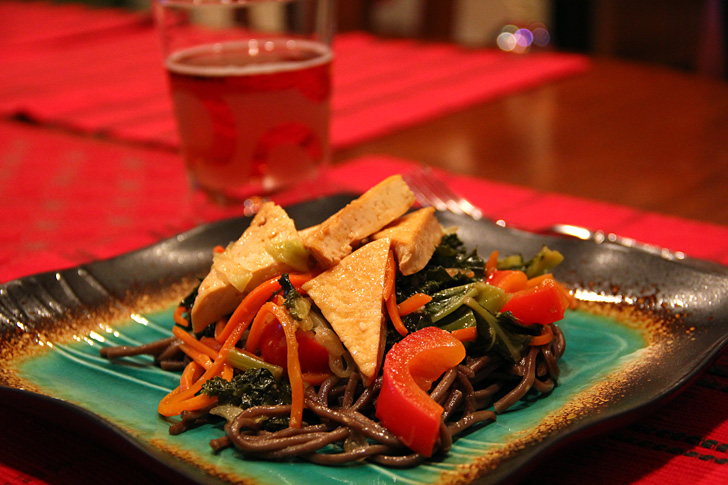
As I am a big fan of all kinds of vegetables, I wanted to mix the tofu with red bell pepper, kale, cabbage and carrot. Before putting all these in the pan, I used the extra marinade to make a sauce by heating it and thickening it with some potato starch. I added some water as well and let the veggies simmer for a while to soften them. In the end I added the marinated tofu and mixed it with the veggies.

To accompany my stir fry tofu, I boiled some buckwheat (soba) noodles that I had bought from an Asian market. I spiced the boiled noodles with vinegar, oil and salt to add some extra flavor.


And the result? Not bad! Interestingly, I thought that my dish was a little bit salty, but the rest of the family almost wanted to add more salt! The real success of the dish was to find out that dry-frying really works: the tofu had gotten a lot of flavor from the marinade, more than what I’d get without dry-frying it. I recommend!

Not only is tofu a cheap and easy product to use, but it also has many nice health benefits to it. The benefits include lowering the risk of cardiovascular disease and it also contains a lot of essential micronutrients. (3) It is also a good substitute for meat protein when enjoyed with whole grains as it contains 8 grams of protein per 100 g.

100g (3.5 oz.) of product contains 80 kcal, 8.3 g protein, 4.2 g fat of which 0.5g is saturated,
 2.3 g carbohydrates, 0.6 g fiber, 180 mg Calcium, 1.30 mg Iron, 23mg Sodium. (4)

Sources
       3. more information about tofu:  http://www.whfoods.com/genpage.php?tname=foodspice&dbid=111 
       4.  http://www.nal.usda.gov/fnic/foodcomp/search/


Wednesday, November 9, 2011

Questions, comments?

I invite you to voice your thoughts or your questions and in fact, I would highly appreciate any feedback or questions you might have. If there is a subject you would like me to talk about, let me know!

Anna-Kaisa

Salt

My husband requested that I talk about salt: something that he finds he eats too much of.

On average, Americans consume 3,400 mg of sodium every day. At the same time, the recommended intake has been recently reduced from 2,400 mg to 2,300 mg of sodium per day. (2,400 mg sodium translates to 5,75 grams or a little over a teaspoon of table salt, i.e. sodium chloride). (1)

For African-Americans and for individuals who are 51 years and older or who suffer from hypertension, diabetes or chronic kidney disease, the recommendation is 1,500 mg sodium per day (3,75g salt). (1)

In today's busy lifestyle, it is easy to get too much salt. Often, there is no time to cook at home, and so the tendency is to either buy ready-made foods in the stores or opt out for a meal at a restaurant. Both types of foods usually contain more salt than what we'd add to the food we cook ourselves, thus increasing the our intake of salt.

What makes salt unhealthy is the sodium it contains: sodium raises blood pressure by hardening the arteries, which in turn forces the heart pump blood more vigorously. Raised blood pressure then leads to cardiovascular disease, kidney disease and congestive heart failure. (1)
 
Even though it seems that salt is only bad for you, it also has important tasks in our bodies. Sodium helps transmit information through the nerves and also helps maintain the electrolyte and fluid balance in the body. Also, sodium is needed in the absorption of certain nutrients from the small intestines. Thus, we all need salt and furthermore, need to get salt by eating it, as the body can't produce it. (2,3) Still, we get enough salt from the foods we eat without adding any salt, so there is no real danger of getting too little salt if you eat normally.

How to decrease the intake of salt, then? The easiest way is to cook food at home instead of buying processed foods: it is easier to control the amount of salt in the food we eat by making it ourselves. If there simply isn't time to cook and one must rely on restaurants and processed foods, then I recommend choosing foods that are low in sodium; some restaurants have such items on the menu, and if they don't, it should be possible to request food that has less added salt. And, try not to add any more salt to your food when on the plate in front of you.

Also, snack foods, like potato chips, tend to contain plenty of salt. Many cheeses, sausages and other processed milk and meat products tend to have very high amounts of salt as well. Check out the labels, you will soon detect the healthier foods among the salty ones.

My favorite way to decrease sodium intake is to use mountain salt instead of basic table salt. Unfortunately it is more expensive than normal salt but it helps decrease the amount of sodium in my cooking without affecting the taste! If you are interested in mountain salt, here's an article that has more information: http://www.thehealthbank.co.uk/nutrition_articles/salt.html 

I hope this is helpful to you. If you have any questions about salt, or anything else, please ask! Also, if you have any ideas to further cut down on salt, please share :).

Anna-Kaisa

References:
1. USDA (http://www.cnpp.usda.gov/Publications/DietaryGuidelines/2010/PolicyDoc/Chapter3.pdf) 10/30/2011

2. The Royal Society of Chemistry: (http://www.rsc.org/Chemsoc/Chembytes/HotTopics/Salt/whysalt.asp ) 10/30/2011

3. Nutritionvista: http://www.nutritionvista.com/Wellness/the-importance-of-salt-in-diet,31.aspx) 10/30/2011


Wednesday, September 21, 2011

I love oatmeal!


My first blog entry I want to dedicate to… oatmeal! It is the best way to start a day – hands down. A big bowl of oatmeal can keep me satisfied for hours and there’s no need to snack before lunch. I know what you think:  it’s all very nice but admit it, oatmeal tastes like cardboard. I can assure you that with a little bit of ingenuity, you can create a delicious breakfast that you don’t want to give up!

To be honest, plain oatmeal does taste quite boring. But a great thing about oatmeal is that it works well with almost anything! For example you can add any kind of berry or fruit in it and instantly add flavor and texture. Oatmeal is good for you: to start with, it contains soluble and insoluble fiber that help your stomach work like it should. Adding nutritious value is also very easy, with wheat bran and ground flax seed to name a few. 


Ways to make oatmeal taste great:

-         Add berries or fruit. Any kind works, my favorites are blueberries, raspberries and banana and it is fun to try new ones. Dried fruit and berries work well too. Adding fruit or berries also increases the amount of fiber and other nutrients while adding just a few calories. The complex sugars in fruit and berries don’t raise the blood sugar fast, which keeps energy levels more even.

-         Add jam or fruit preserve. These contain more sugar, but in my opinion, it is better to have the oatmeal with a little sugar than not at all. 

-         Add berry soup. If homemade, it is easier to control the amount of sugar added in it. My mom made the best soups from frozen strawberries, blueberries or raspberries. 

-         Add honey, maple syrup or other sweetener. Again, if this is how you like your porridge, have it with sugar rather than skip the whole thing. Oatmeal’s benefits are valid even with some added sugar.

-        Add milk, soy milk, rice milk, almond milk or other. My favorite is almond milk: it tastes great with oatmeal and adds nutritional value and just a few calories.

Feel free to mix and match!

To add nutritional value: 

-        Add ground flax seed. It adds fiber and other nutrients, as well as important omega-3 and omega-6 fatty acids. Flax seed doesn’t alter the flavor and gives the porridge a nice soft texture. Typically I add 1-2 tablespoons of flax seed to a portion of oatmeal.

-        Add wheat bran. Wheat bran contains a ton of fiber. The daily recommendation for fiber intake is 28-38 grams in a diet of 2000 Calories. The intake of 35-38 grams can lower the risk of cancer. A word of warning: if large amounts of fiber are consumed, one should remember to drink plenty of water, because too much fiber can create a blockage. Still, on average the Americans consume only 11 grams of fiber each day, so for most people there is no real risk of eating too much fiber (all this I learned at my biology class lately). I use around 1-2 tablespoons per portion.

-        Add oat bran. Oat bran contains water soluble fiber, which helps the good bacteria in the intestines thrive and keep you healthy. I like to substitute half of the oat flakes with oat bran when making oatmeal. A porridge made only from oat bran is also very tasty.


To make oatmeal: 

Making oatmeal is really easy and fast. If using instant oat flakes, the porridge is ready in 1 minute in the microwave. You can follow the instructions in the package and choose your mode of preparing it, but generally I:

measure oatflakes and water into a bowl and microwave high for 1-3 minutes, depending on the kind of flakes I am using and how big amount is being made. Milk or plant based milk can be used instead of water. Typically, the ratio of oat flakes and liquid is 1:2. You can try which consistency you like the best and increase or decrease the amount of water. If wanted, a dash of salt can be added for flavor.

A small portion for example would consist of 1/2 cup (c. 1 deciliter) of flakes and 1 cup (c. 2 deciliters) of water. If using oat bran or ground flax seed, add them before putting into the microwave, oat bran might also need more cooking time. Wheat bran can be added to a ready porridge.Oatmeal boils over easily, so keep an eye on a big portion. 

Nutritional details, 50 grams or c. 1.7 ounces oat flakes:

186 Calories, 6.9 grams protein, 3.5 grams fat, 34 grams carbohydrates, 4.7 grams fiber, 0.7 grams sugar. Contains also minerals, such as iron.

Source: USDA National Nutrient Database http://www.nal.usda.gov/fnic/foodcomp/search/